
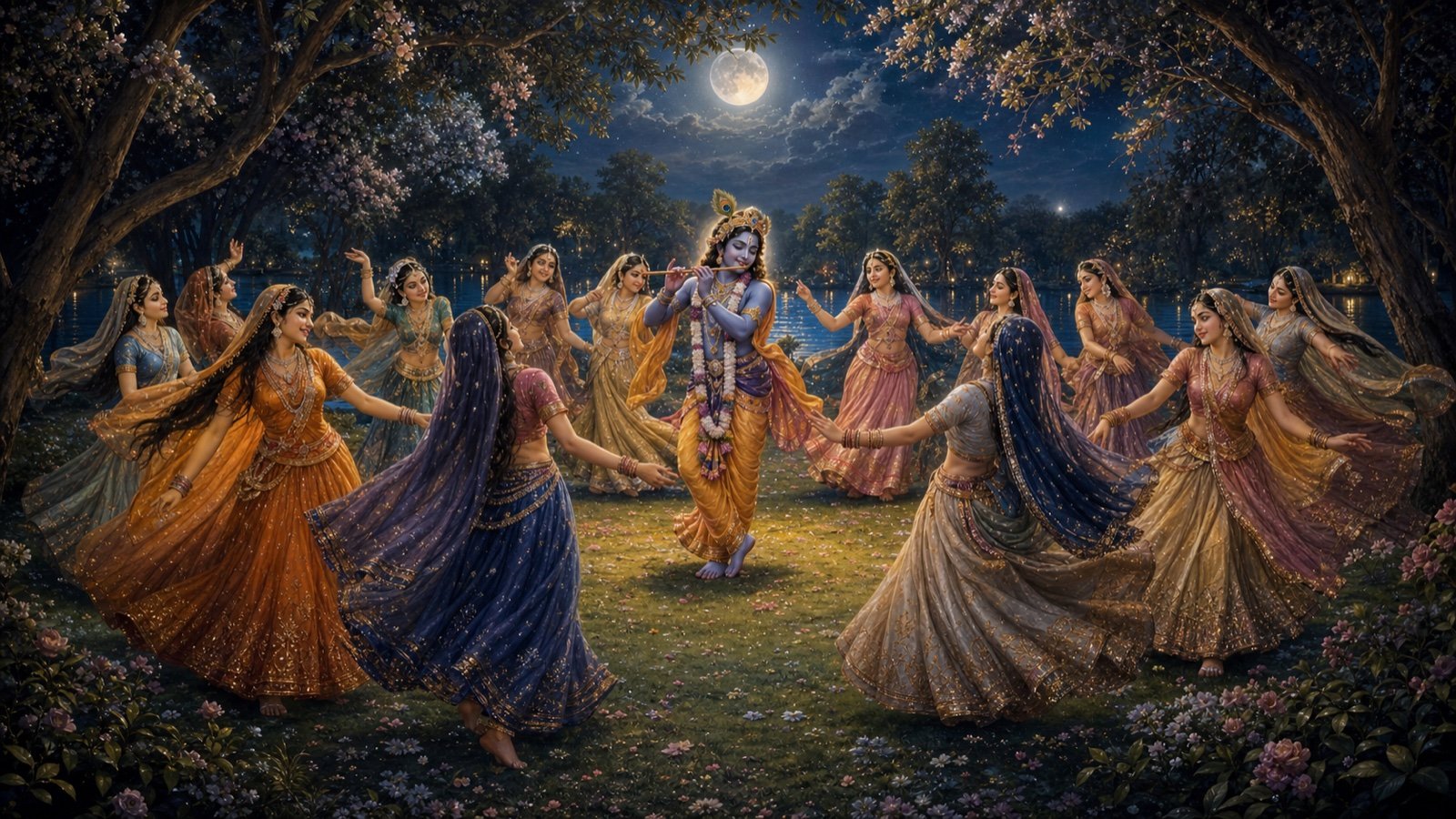
The Divine Dance of Love: The Story of Raaslila
In the sacred groves of Vrindavan, under the light of a full autumn moon, the air once trembled with the melodious notes of a divine flute. That flute was not an ordinary instrument—it was the voice of Krishna, the Supreme Lord in human form, calling not to command, but to awaken the deepest longing in the hearts of his beloved devotees: the Gopis of Vrindavan.
This was no ordinary night, and what followed would be etched in eternity as the Raaslila—a divine dance of love, devotion, and cosmic mystery.
🌕 The Moonlit Prelude
It was the night of Sharad Purnima, a night considered supremely auspicious in Hindu tradition. The moon shone brighter than ever, bathing the forests of Vrindavan in silver light. The trees were fragrant, the Yamuna flowed gently, and nature seemed to pause in awe.
As Krishna stood by the Kadamba tree, he played his flute—a call so sweet, so irresistible, that it stirred the hearts of the Gopis, the cowherd women of Vrindavan. Hearing it, they dropped everything—their chores, their families, even social conventions—and ran toward the source of that divine melody.
This moment is described vividly in the Bhagavata Purana (Srimad Bhagavatam), Canto 10, Chapter 29:
“tāḥ śrutvā yamunā-kūle, ’krīḍan-venum adṛtya ca
jahur gṛhān paśūn bālāḥ, kāntārāṇi ca sarvaśaḥ”
(SB 10.29.4)
“Upon hearing the sound of Krishna’s flute, the Gopis abandoned their homes, their families, and all duties to rush to him in the forest.”
Their souls had long been bound in love and devotion to Krishna. This wasn’t worldly love; it was parama-prema—the highest, unconditional divine love.
💃 The Circle of Bliss Begins
When the Gopis reached Krishna, they were both ecstatic and shy. Krishna, in his playful mood, teased them.
“Why have you come into the forest at night? Don’t you know it’s dangerous? Go back to your families,” he said with a mischievous smile.
But the Gopis, deeply wounded by the suggestion, replied with teary eyes that their love for Krishna wasn’t ordinary affection—it was a spiritual surrender. They had forsaken everything, not for personal pleasure, but because they recognized Krishna as their very soul’s beloved.
Moved by their devotion, Krishna accepted their love, and thus began the Raaslila, the transcendental dance between God and the soul.
Described in Bhagavata Purana, Canto 10, Chapter 33:
“tābhiḥ sa rāsa-krīḍāṁ, cakre ātmātma-māyayā
ānandam udvahann eva, bhagavān devakī-sutaḥ”
(SB 10.33.1)
“With those Gopis, Lord Krishna performed the Raasa dance, manifesting himself in many forms beside each of them, delighting them and himself.”
In the dance, Krishna expanded himself into multiple forms, so that each Gopi felt he was dancing with her alone. This divine multiplication (yogamaya) is not a metaphor—it is described as a leela, or divine play, beyond the logic of the material world.
🌀 The Cosmic Symbolism of Raaslila
Raaslila is more than just a dance—it is a cosmic metaphor.
-
Krishna is the Supreme Self (Paramatma), the divine consciousness.
-
The Gopis represent individual souls (Jivatmas) consumed by love and longing for union with the Divine.
-
The circle of the dance is symbolic of samsara, the cycle of life, where each soul moves around the center, which is Krishna.
Krishna becomes the axis of the wheel of life, and those who surrender in love dance in harmony with him.
This mystical understanding is explained in Vaishnava commentaries like those of Srila Jiva Goswami and Srila Vishwanath Chakravarti Thakur, who describe Raaslila as the pinnacle of Bhakti Yoga, where love surpasses even the path of knowledge and renunciation.
🔥 Was the Raaslila Sensual? The Truth
Many critics and skeptics have misunderstood the Raaslila as a romantic or even sensual act. But the Bhagavata Purana strongly rebukes such interpretations.
“naitat samācarej jātu, manasāpi hy anīśvaraḥ
vinaśyaty ācaran mauḍhyād, yathā ’rudro ’bdhi-jaṁ viṣam”
(SB 10.33.30)
“One who is not the Supreme Lord should never imitate this Raasa dance. To do so is as foolish as drinking poison like Lord Shiva did.”
This clarifies that Raaslila is not to be imitated or interpreted in a mundane way. Krishna is Atmarama, self-satisfied, beyond desires. His union with the Gopis was not physical but spiritual, designed to bless them and the universe.
🪷 The Gopis: Saints Beyond Measure
The Gopis are considered the greatest devotees of Krishna, and their love is seen as the highest expression of Bhakti in Gaudiya Vaishnavism.
In Bhagavata Purana, Canto 10, Chapter 32:
“nāyaṁ śriyo ’ṅga u nitānta-rateḥ prasādaḥ
svar-yoṣitāṁ nalina-gandha-rucāṁ kuto ’nyāḥ
rāsotsave ’sya bhuja-daṇḍa-gṛhīta-kaṇṭha-
labdhāśiṣāṁ ya udagād vraja-striṇām”
(SB 10.32.22)
“What fortune do the Gopis of Vraja possess, having achieved the embrace of Krishna during the Raasa dance, which even the goddess Lakshmi desires in vain?”
Even Lakshmi, the goddess of fortune, desires such intimate union with Krishna but could not achieve it.
🌸 Legacy and Celebration
Raaslila is celebrated to this day in the dance-dramas of Vrindavan, Manipur, and other places with deep Bhakti traditions. It has inspired countless poets like Jayadeva, Surdas, Vidyapati, and Chaitanya Mahaprabhu, who saw Raaslila not as a tale of lovers, but as the soul’s cry for divine embrace.
🧘♀️ Spiritual Takeaway
The Raaslila teaches us that:
-
The Divine responds to pure love, not qualifications.
-
True surrender means forgetting ego, society, and selfishness.
-
The soul can achieve union with God, not through rituals or knowledge alone, but through bhakti infused with total selflessness.
📚 Scriptural References
-
Bhagavata Purana (Srimad Bhagavatam) – Canto 10, Chapters 29–33
-
Harivamsa Purana – Vishnu Parva
-
Garga Samhita – Detailed elaboration on Raaslila
-
Commentaries by Acharyas like Srila Prabhupada, Jiva Goswami, and Vishwanath Chakravarti Thakur