

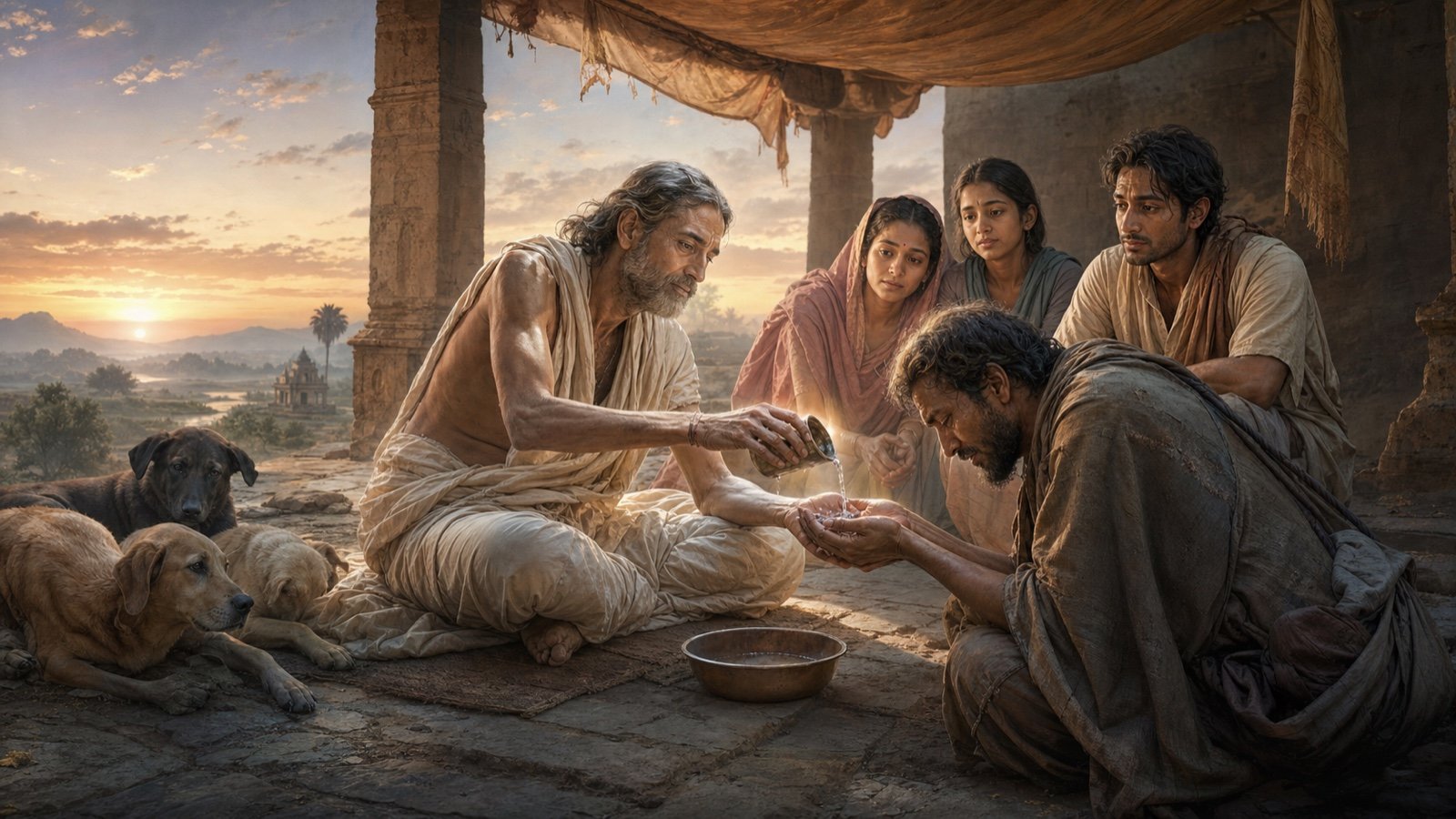
After forty-eight days without food or water, King Rantideva finally received a simple meal. Before he could taste it, four guests arrived—one after another—and compassion asked him for everything.
There are kings remembered for the cities they built, the armies they commanded, or the lands they conquered. Rantideva is remembered for something that fit inside two hands: a final cup of water that he chose not to drink.
His story appears briefly in the Ninth Canto of the Śrīmad Bhāgavatam, yet its few verses hold an immense question. When survival itself is at stake, where does generosity end?
For Rantideva, it did not end at the boundary of his own body.
A King Who Kept Nothing
Rantideva was born in the lineage of Bharata. He possessed the dignity of a ruler, but he did not cling to royal comfort. Whatever came to him through providence, he shared. Food passed through his hands to the hungry. Wealth reached him and moved onward. He did not give because his storehouses were always full; he gave because he saw the same Lord dwelling in every living being.
Over time, almost nothing remained.
His family accepted the same austere life. They knew hunger, weariness, and uncertainty. Still, the king did not turn his compassion into a calculation. He did not ask whether a visitor had earned help, whether generosity would improve his reputation, or whether enough would remain for tomorrow.
Then came a season of terrible scarcity.
One day passed without food. Then another. The days gathered into weeks. According to the Bhāgavatam, forty-eight days went by while Rantideva and his family had neither eaten nor even drunk water.
By the dawn of the forty-ninth day, their bodies trembled. Their mouths were dry, their strength nearly gone. At last, food arrived: preparations made with grain, milk, and ghee, together with a little water.
It was not a royal feast. To the starving family, it was life itself.
The First Guest
The family sat before the meal. Every breath seemed to lean toward it.
At that exact moment, a brāhmaṇa appeared at the threshold and asked for food.
Rantideva looked at the guest, then at the meal. He did not see an interruption. He saw Hari—the Supreme Lord—present within the person before him. With reverence and faith, he offered the visitor a share.
The guest ate and departed.
The family divided what remained. Their portions were smaller now, but relief was still close. Rantideva lifted his food.
A second stranger arrived.
When Hunger Comes Back to the Door
This visitor was from a different social station, but hunger had made all such distinctions meaningless. He asked for something to eat.
Again Rantideva remembered the Lord within the guest. He gave away his own portion.
The stranger ate and went on his way.
Very little food remained. Before the family could finish it, a third traveler approached. Several hungry dogs followed him closely. Their ribs showed through their coats; their eyes remained fixed on the food.
“O King,” the man pleaded, “please give something to me and to these dogs.”
Rantideva bowed to them. He placed all the remaining food before the man and his animals, honoring every life gathered at his door.
They ate. Nothing solid was left.
Only a small vessel of water remained.
The Last Cup
Rantideva’s throat burned. His body was faint with thirst, and the water in his hands was barely enough to keep one person alive. Food could no longer help him, but this final drink might.
As he raised the cup, a fourth traveler stumbled toward him.
The man was exhausted and parched. He belonged to a community that society pushed outside its boundaries. He did not demand the water. He simply asked for mercy.
Rantideva heard more than a request. He heard the suffering of a living being who wanted to remain alive.
His hands lowered.
“I do not seek mystical powers, nor even freedom from rebirth. May I remain among living beings and bear their pain, so that they may be released from suffering.”
This is the heart of Rantideva’s prayer, rendered from Śrīmad Bhāgavatam 9.21.12. He did not bargain for a greater reward. He did not offer the water in exchange for heaven. He was willing to let another person’s suffering pass through him if that person could be saved.
He gave the traveler the last cup.
The man drank.
Rantideva remained without food or water, yet the Bhāgavatam describes him as becoming free from hunger, thirst, fatigue, grief, and bewilderment. Compassion had not strengthened his body. It had carried his awareness beyond the prison of the body’s fear.
When the Masks Fell Away
Then the humble shelter changed.
The visitors revealed their true identities. The brāhmaṇa, the second guest, the man with the dogs, and the thirsty traveler had been manifestations arranged through the divine energy of Lord Viṣṇu. The rulers of the three worlds stood before Rantideva in their celestial forms.
They had not come because the gods needed his meal. They had come to reveal what remained in him when everything else was taken away.
Nothing material remained—yet his devotion remained.
The divine beings were capable of granting prosperity, power, and heavenly rewards. Rantideva asked for none of them. He bowed and fixed his mind only upon Vāsudeva, the Supreme Lord. Because his service carried no hidden desire, the glitter of worldly illusion held no more weight for him than a dream after waking.
Those who followed Rantideva were transformed by his example. The scripture says they too became devoted servants of Lord Nārāyaṇa.
The Vision Behind the Gift
Rantideva’s greatness does not lie only in the quantity he surrendered. The greater teaching is the way he saw.
He did not help the first visitor because that person held a respected position and then turn away from those of lower status. The guests arrived across the social world of his time, followed even by hungry animals. Rantideva’s reverence did not diminish as convention placed each visitor farther from privilege. In everyone, he remembered Hari.
His compassion was therefore more than kindness. It was theology made visible.
To claim that the Divine lives in every heart is a beautiful belief. To give away one’s final cup because of that belief is realization.
What Rantideva Teaches Us
Give without ranking who deserves compassion
The story deliberately widens Rantideva’s circle of care. A respected guest, an ordinary laborer, a traveler with dogs, and an excluded stranger all receive the same sacred attention.
See the person, not the label
Rantideva responds to hunger and thirst before he responds to social identity. Devotion sharpens his attention to another being’s pain.
Generosity reveals what we worship
Giving from abundance is good. Giving when fear says “keep this for yourself” exposes the deepest center of the heart.
Compassion can be a form of liberation
Rantideva does not seek escape from the world’s suffering. He seeks such complete union with living beings that their freedom matters more to him than his own.
The Cup in Our Hands
Most of us will never face Rantideva’s extreme test, and the story does not ask us to neglect the real responsibilities of caring for ourselves and our families. It asks a quieter, more persistent question: when something precious reaches our hands, do we see it only as possession, or also as possibility?
Our “last cup” may be time offered to someone who feels unseen. It may be food shared without judgment, patience given when irritation would be easier, or dignity extended where society withholds it.
Rantideva’s palace had become empty. His body had almost nothing left. Yet at the doorway of that emptiness, the Divine kept arriving in another face.
And every time, the king opened the door.
Scriptural Basis
This is an original literary retelling based on Śrīmad Bhāgavatam, Canto 9, Chapter 21, especially verses 2–18. It preserves the chapter’s sequence while adding fresh scene-setting and reflection for modern readers.
- Śrīmad Bhāgavatam 9.21 — the full account of King Rantideva
- Śrīmad Bhāgavatam 9.21.12 — Rantideva’s prayer of compassion
- Śrīmad Bhāgavatam 9.21.15 — the visitors reveal their divine identities
The vessel became empty. The heart did not.
May Rantideva’s story remind us that every act of compassion can become an offering to the Lord who lives in all beings.