
King Bharata had renounced a kingdom, a family, and every royal comfort for the sake of God. Then an orphaned fawn entered his hermitage—and compassion slowly became the one attachment he had not learned to release.
Some dangers announce themselves with a roar. Others arrive trembling in our hands.
The story of King Bharata and the deer, told in the Fifth Canto of the Śrīmad Bhāgavatam, is not a warning against kindness. Bharata’s first response to the helpless animal is noble and necessary. The story asks a subtler question: when does loving care cease to serve another life and begin to occupy the place within us that belongs to the Divine?
Bharata learned the answer across two births.
The Emperor Who Walked Away
Bharata was the eldest son of the great King Ṛṣabhadeva. He ruled with wisdom and a caring heart, performed his duties faithfully, and guided his people toward dharma. The Bhāgavatam says that the land once known as Ajanābha came to be celebrated as Bhārata-varṣa during his reign.
Yet Bharata never mistook a throne for his deepest identity.
When the proper time came, he divided the kingdom among his five sons. He did not wait for age or defeat to tear power from his hands. He placed the crown down willingly, left the palace, and travelled alone to the sacred hermitage of Pulaha near the Gaṇḍakī River.
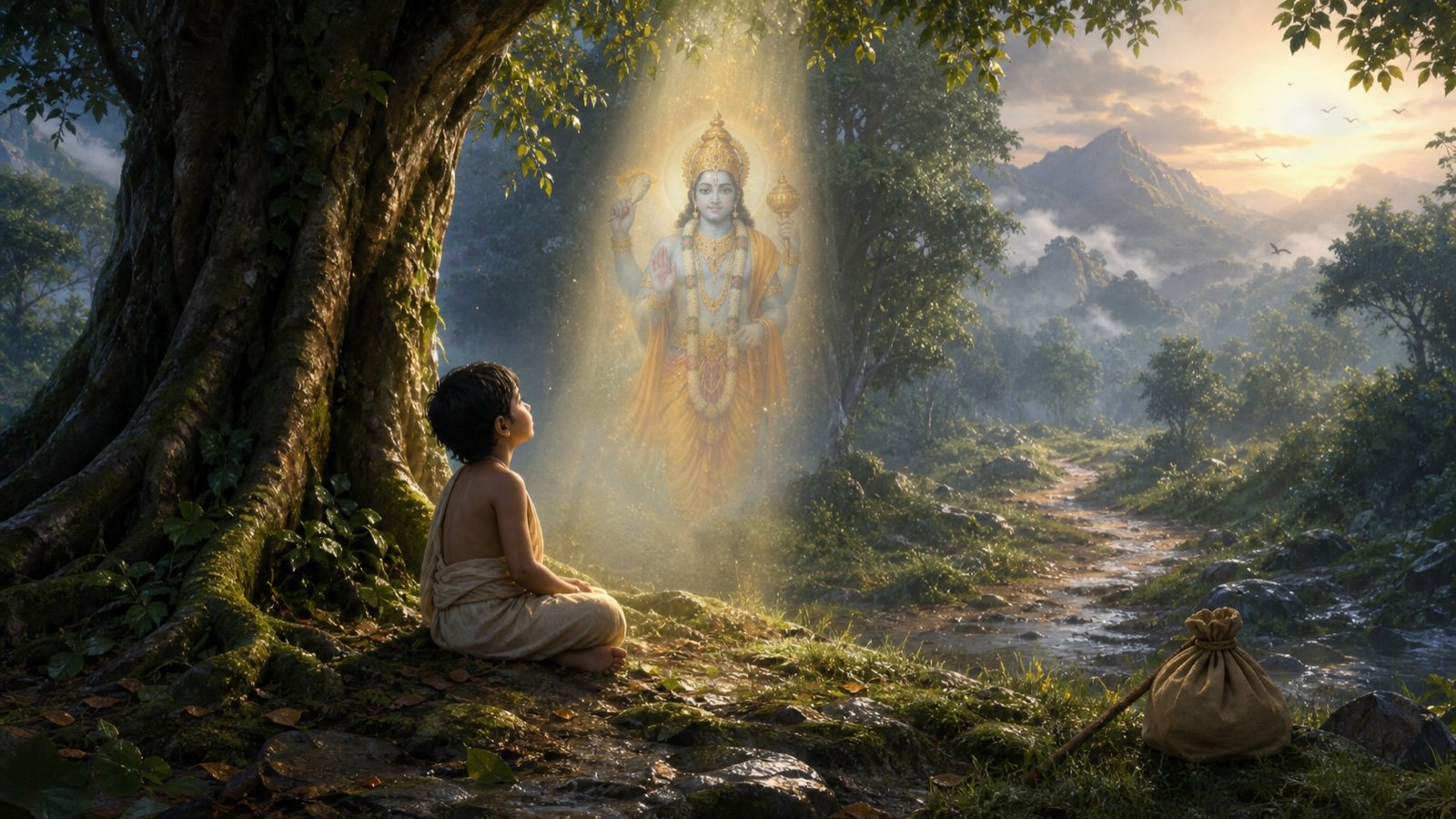
There, surrounded by forest and flowing water, the former emperor lived simply. He gathered flowers, leaves, fruits, and clear water for worship. His mind became increasingly absorbed in Lord Vāsudeva. The signs of status disappeared from his daily life until there remained only a seeker, a river, and remembrance.
The man who had governed a nation had learned to govern his attention.
A Roar Across the River
One morning, after bathing in the Gaṇḍakī and completing his daily observances, Bharata sat on the bank and chanted the sacred syllable Om.
A pregnant doe stepped cautiously from the trees. Thirst had drawn her to the river. She lowered her head and began to drink.
Then a lion roared somewhere in the forest.
The sound broke across the valley. Terrified, the doe leapt over the current before she had finished drinking. The strain and fear caused her unborn calf to fall into the river. Exhausted by the leap and separated from her herd, the mother reached a cave and died.
The newborn fawn was carried helplessly through the water.
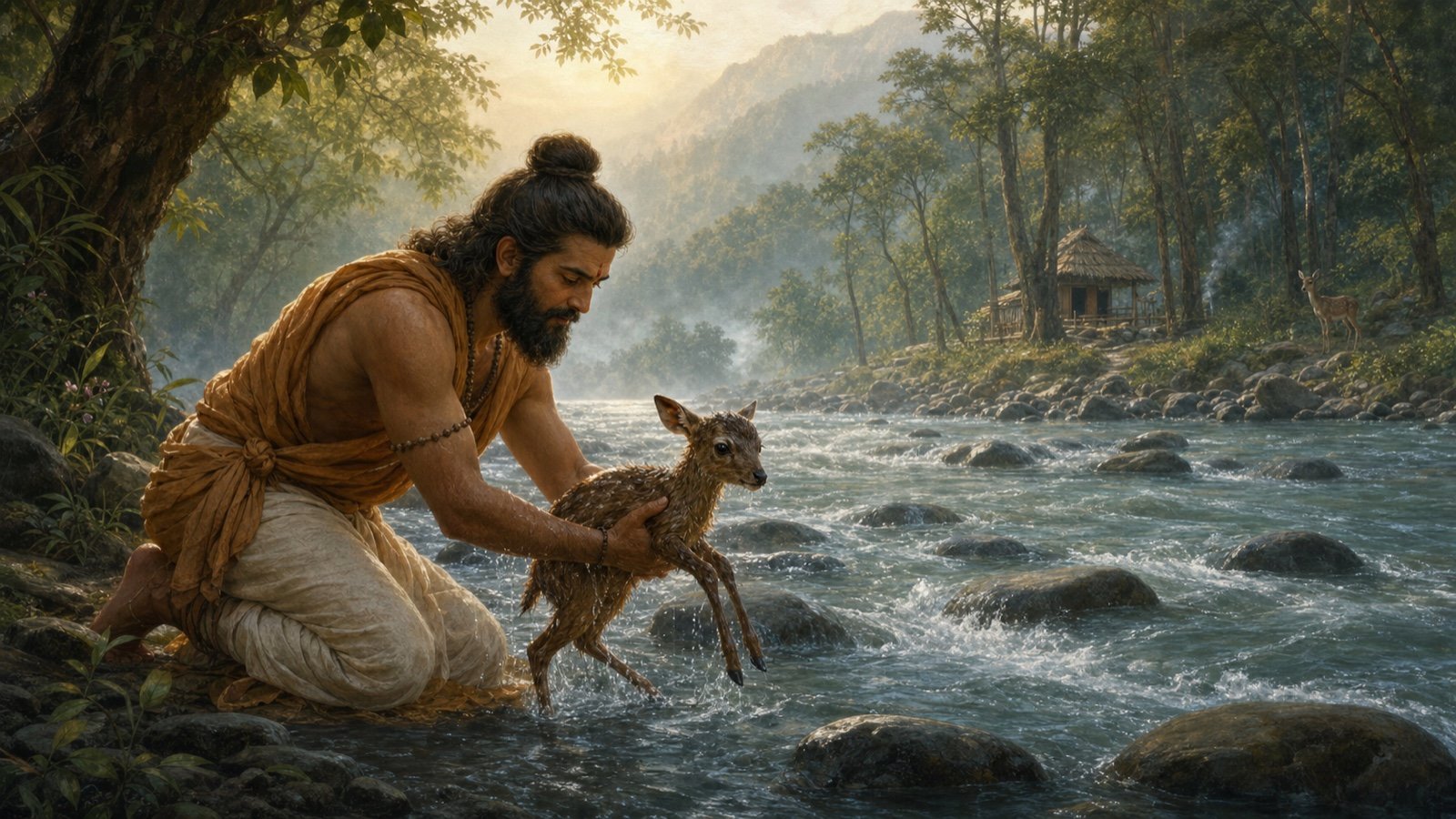
Bharata rose at once. He entered the stream, reached through the current, and lifted the small creature into his arms. Its body trembled against him. Wet, motherless, and unable to survive alone, it had no shelter except the ascetic who had found it.
Bharata carried the fawn back to his hermitage.
Compassion required that much.
The Guest Who Became the Center
At first Bharata’s care was simple. He fed the fawn tender grass, protected it from wild animals, kept it warm, and led it safely near the hermitage. It followed him with complete trust.
Days passed. The fawn learned his voice. It rested beside him and nudged him for affection. Bharata began to think of it as his own child.
His tenderness deepened—but so did his anxiety.
During worship he wondered whether the deer was safe. While gathering flowers he searched the trees for danger. When the animal wandered out of sight, the stillness that once supported meditation became unbearable. His mind followed the fawn into the forest.
The Bhāgavatam says that Bharata gradually neglected his spiritual disciplines, self-restraint, and worship of the Supreme Person. He had renounced sons, wealth, and empire; now a small deer quietly occupied the throne within his attention.
Attachment does not always enter looking like desire. Sometimes it arrives disguised as the fear that love cannot survive without our control.
Care and Attachment Are Not the Same
The story does not condemn Bharata for rescuing the fawn. Abandoning a helpless creature would not have been detachment; it would have been indifference.
His difficulty began when care lost its spiritual center.
Compassion asks, “What does this being truly need from me?” Attachment asks, “How can I keep this being close so that I do not suffer?” Compassion can act fully and still leave room for trust. Attachment makes the mind circle endlessly around imagined loss.
Bharata’s actions continued to look gentle. He carried the fawn on his shoulders, sheltered it on his lap, and worried about its safety. But inwardly, remembrance of God was being replaced by possession, and service by fear.
One day the deer wandered away for longer than usual.
Bharata searched the forest in distress. He studied hoofprints in the earth. He looked toward the moon and imagined that its dark markings resembled his deer resting there for protection. Every shadow became a possible threat; every silence, a sign of disaster.
The emperor who had once surrendered a whole kingdom could no longer surrender one creature to the care of Providence.
The Thought at the Final Door
Time continued its unseen approach.
When Bharata’s final moment came, the deer sat near him. Instead of resting his awareness in Vāsudeva, Bharata looked upon the animal and worried about what would happen after he was gone.
His last thought followed the path his mind had practiced each day.
The Bhāgavatam teaches that the state of consciousness at death carries the soul toward its next embodiment. Because Bharata’s mind was absorbed in the deer, he was born again in the body of a deer.
The fall seems devastating. A king who had reached the threshold of spiritual perfection had been redirected by a single attachment.
Yet divine mercy had not abandoned him.
Memory Inside Another Body
In his deer birth, Bharata remembered.
He remembered the palace he had renounced, the hermitage beside the river, the spiritual practice he had neglected, and the attachment that had shaped his final thought. The body was different, but the lesson remained clear.
Because of that memory, he did not lose himself in the ordinary life of the herd. He left the mother deer who had given him birth and returned to the region of the Pulaha hermitage. He stayed near sages, listened to sacred recitations, and avoided new attachments. He ate dry leaves and grass, waited patiently for the consequences of that body to end, and kept his awareness turned toward the Lord.
What looked like punishment became instruction. The very form produced by his distraction became the place where he completed his understanding.
After the deer’s death, Bharata would be born once more as Jaḍa Bharata. That later life would reveal the strength of a man determined never again to confuse the passing body with the eternal self.
But the seed of that wisdom was planted beside the river, when a compassionate rescue became attachment—and attachment became memory.
What Bharata’s Story Teaches
Kindness is not the problem
Bharata was right to save the fawn. Spiritual life does not ask us to become cold. It asks us to let compassion remain connected to wisdom.
Attention reveals attachment
We may renounce visible possessions while allowing one worry, relationship, role, or ambition to occupy the mind completely. What repeatedly claims our attention is often what we are truly holding.
Love does not require total control
Responsible care acts, protects, and serves. Attachment assumes that another life can remain safe only through our constant possession. Trust is not neglect; it is the humility to recognize the limits of control.
Daily thought prepares the final thought
Bharata did not suddenly remember the deer at death. His mind followed a path worn deep by repetition. The story therefore makes ordinary remembrance sacred: what we return to each day is shaping where consciousness turns under pressure.
Grace can continue through consequence
Bharata experienced the result of his attachment, but he was not spiritually erased. Memory followed him. The Lord’s mercy did not always remove the consequence; it transformed the consequence into a teacher.
The Deer in the Mind
Most of us do not live in forest hermitages, yet the mind still finds its deer.
It may be a person whose every movement determines our peace, a responsibility we refuse to entrust to anyone else, a project that devours prayer and rest, or an anxiety we repeatedly call “care” because admitting fear would be harder.
Bharata’s story does not ask us to love less. It asks us to love without making another being the foundation of our identity.
We can rescue the fawn. We can feed it, shelter it, and cherish it. But we must remember that both the one who protects and the one who is protected remain held by a greater Presence.
Compassion opens the hand.
Attachment closes it.
Devotion teaches us how to care with an open hand.
Scriptural Basis
This is an original literary retelling based on Śrīmad Bhāgavatam, Canto 5, Chapters 7–8. It preserves the narrative sequence while adding fresh scene-setting and reflection for modern readers.
- Canto 5, Chapter 7 — Bharata’s reign, renunciation, and worship at Pulaha’s hermitage
- Canto 5, Chapter 8 — the orphaned fawn, Bharata’s attachment, and his deer birth
- Śrīmad Bhāgavatam 5.8.7 — Bharata rescues the fawn from the river
- Śrīmad Bhāgavatam 5.8.31 — his final days in the body of a deer
Care deeply. Hold lightly. Remember what holds us all.