
At the end of a life he regretted, Ajāmila called out the name “Nārāyaṇa”—meaning only to summon his youngest son. The child came running, but so did a grace the old man had forgotten.
A name can live in a house for years before its deepest meaning is heard.
Ajāmila spoke “Nārāyaṇa” every day. He called it across rooms, whispered it while feeding his little boy, and repeated it with the ordinary affection of an aging father. He did not imagine that the name was preparing a doorway inside him.
The Śrīmad Bhāgavatam tells his story not to make wrongdoing seem harmless, but to reveal the astonishing power of remembrance—and what a person must do when grace gives him another chance.
A Disciplined Beginning
Ajāmila did not begin life as the man he later became.
He was born in Kānyakubja and raised in a learned brāhmaṇa family. As a young man he studied sacred texts, spoke truthfully, served his elders, practiced self-control, and performed his duties with care. His habits were orderly, and his mind had been trained toward purity.
One day his father sent him into the forest to gather fruits, flowers, and materials for worship. On the path home, Ajāmila saw an intoxicated couple openly absorbed in passion.
The sight entered his unguarded mind. The Bhāgavatam describes him struggling to steady himself with the knowledge and discipline he had learned. Yet instead of turning away and protecting the inner life he had built, he repeatedly entertained the desire. Thought became fascination; fascination became decision.
No one stole Ajāmila’s character from him. His fall unfolded through choices he continued to make.
The Long Distance from Himself
Ajāmila abandoned the responsibilities of his former life and joined himself to the woman he desired. To support the household that grew around them, he turned to deception, gambling, theft, intimidation, and other harmful acts.
Years passed.
The young student who had once gathered flowers for worship became difficult to recognize. He learned to silence remorse, then forgot that he had silenced it. Wrongdoing became livelihood, livelihood became habit, and habit became identity.
He and his partner had ten sons. The youngest was born when Ajāmila was already old, and they named the child Nārāyaṇa.
The boy became the center of his father’s heart.
Ajāmila delighted in the child’s broken speech and unsteady steps. While eating, he fed him. While drinking, he gave him water. He called the boy constantly:
“Nārāyaṇa, come here.”
“Nārāyaṇa, sit beside me.”
“Nārāyaṇa, where have you gone?”
The divine name returned to Ajāmila’s tongue, not through spiritual discipline, but through ordinary parental love.
He did not notice that his own final day was approaching.
Visitors at the Bedside
Ajāmila was eighty-eight years old when his body began to fail.
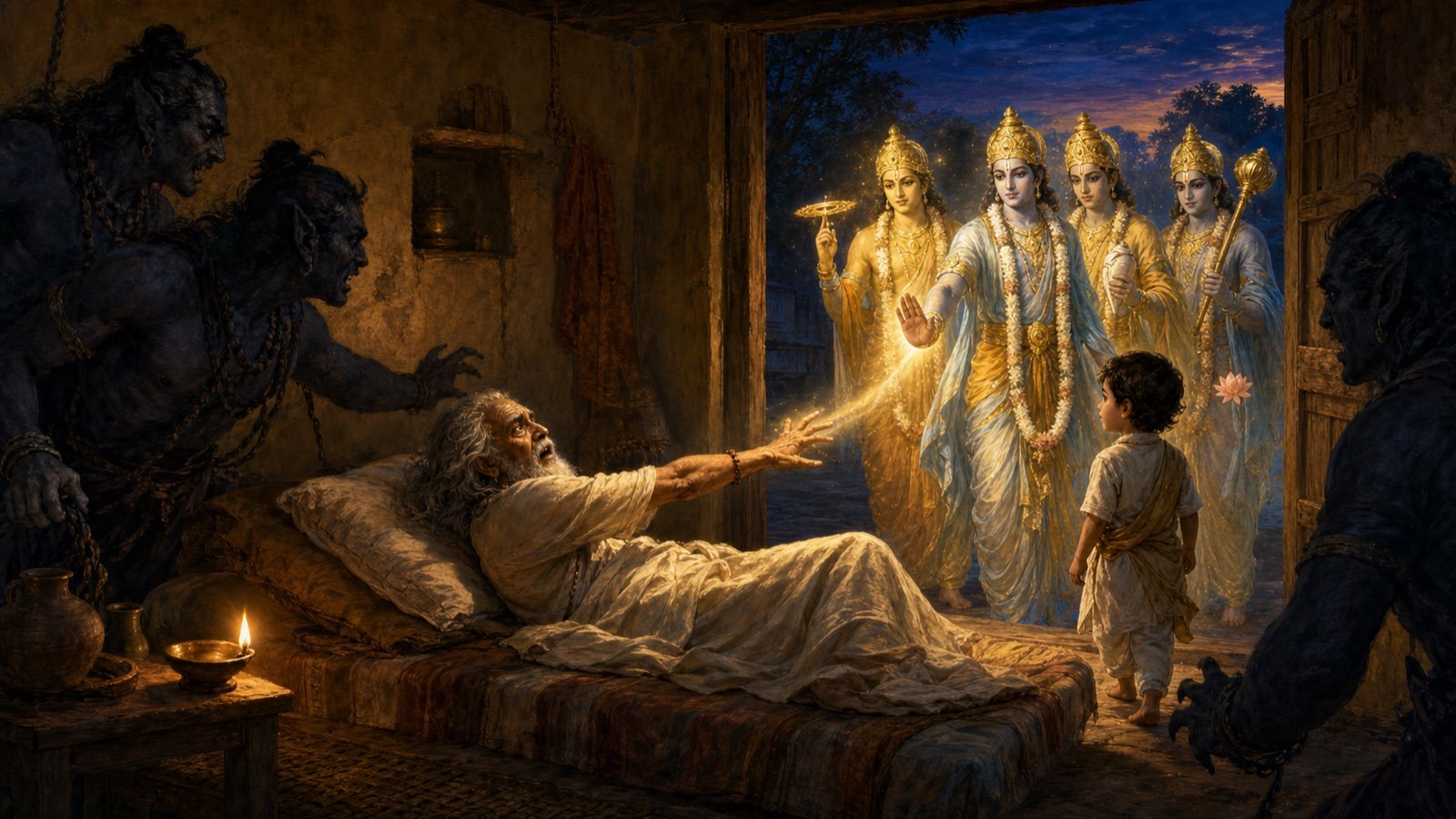
As he lay helpless, he saw three terrifying beings enter the room. They carried nooses and bore the authority of Yama, the lord who administers justice after death. These Yamadūtas had come to draw the subtle self from the body and take Ajāmila toward the consequences of the life he had lived.
The old man’s practiced excuses disappeared. His learning, long neglected, could not be summoned. His family could not follow where he was being taken.
In terror, Ajāmila saw his little son nearby and cried out with all the strength left in him:
“Nārāyaṇa!”
He meant, “My child, come to me.”
But Nārāyaṇa is also the name of the Supreme Lord.
When the Name Answered
Before the messengers of Yama could complete their task, four radiant beings appeared. They were the Viṣṇudūtas, attendants of Lord Viṣṇu. Their presence filled the room with a light that the servants of death could not cross.
“Stop,” they commanded.
The Yamadūtas were astonished. They had measured Ajāmila’s actions. They knew the harm he had done and the duties he had abandoned. By every calculation familiar to them, he belonged in their custody.
What authority could interrupt justice at its final moment?
The Viṣṇudūtas asked them to define dharma. Was a person nothing more than the worst account of his past? Could an act of divine remembrance—however incomplete its intention—have no power to change the condition of the heart?
Ajāmila had called his son, not consciously prayed for liberation. Yet the name itself was not ordinary sound. Through years of affection he had repeatedly pronounced “Nārāyaṇa,” and at the most helpless moment of his life, that name rose without calculation.
The servants of Viṣṇu did not declare his harmful actions good. They declared that the holy name had awakened a spiritual claim deeper than his accumulated sin.
The nooses were lowered.
The Yamadūtas withdrew.
Ajāmila opened his eyes.
Grace Was Not the End of the Story
Ajāmila had heard the entire debate.
He now saw his life without the fog that had protected him from remorse. He remembered the discipline of his youth, the people he had failed, the harm by which he had supported himself, and the long distance he had travelled from truth.
He also understood that he had been given something he had not earned: time.
This is where the story becomes more demanding than a tale of last-minute rescue. Ajāmila did not return to his old habits while claiming that one utterance had made consequences irrelevant. Mercy became the reason he changed.
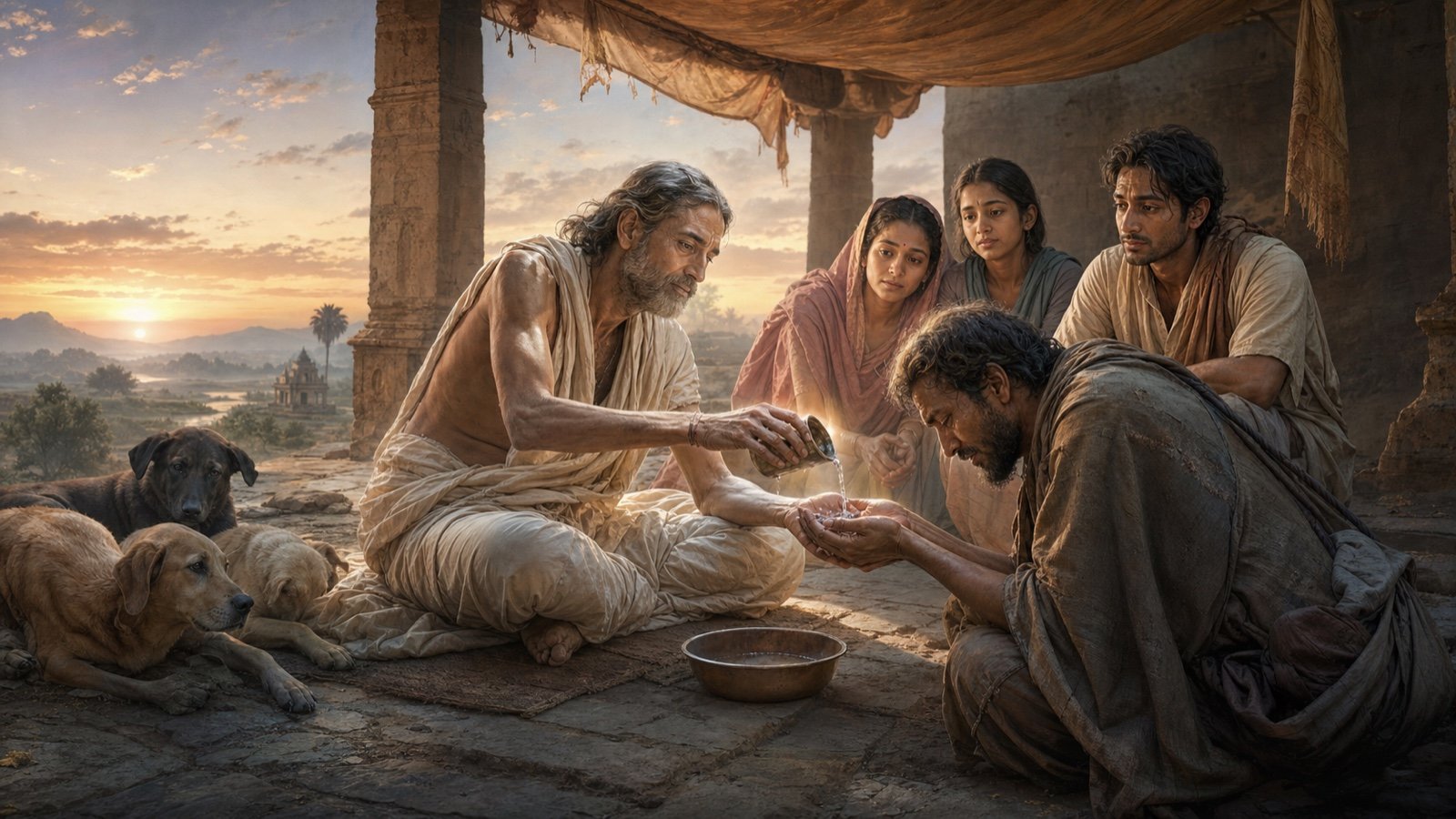
He left his household and travelled to Haridwar on the banks of the Ganges. There he practiced devotion, restrained his senses, contemplated the Lord, and steadily disentangled his awareness from the identity built by years of wrongdoing.
The name he had once spoken accidentally, he now repeated knowingly.
The life that had almost ended in terror became a life of repentance and remembrance.
The Second Arrival
In time, Ajāmila’s heart became clear.
When his next final moment came, he was not calling across a room in fear. His consciousness rested in Lord Nārāyaṇa. The same luminous attendants appeared again—not to argue, but to welcome him.
Ajāmila left his body at the sacred river and attained the Lord’s abode.
The first appearance of the Viṣṇudūtas gave him a second chance. The second confirmed what he had done with it.
Grace does not pretend the past never happened. It prevents the past from becoming the only future possible.
Justice and Mercy in the Same Room
Ajāmila’s story holds justice and mercy together without weakening either.
The Yamadūtas are not portrayed as inventing false charges. Ajāmila had caused real harm. The debate begins because justice has correctly recorded his actions—but has not yet understood the transforming power of devotion.
Mercy does not call darkness light. It introduces a possibility that arithmetic alone cannot measure: a person can awaken.
When Yamarāja later instructs his messengers, he teaches that the devotees of the Supreme Lord do not fall under ordinary jurisdiction. The holy name is not a clever loophole. It belongs to a relationship with the Divine that can reorder the entire being.
Ajāmila’s later life proves the awakening was real.
What Ajāmila Teaches Us
A fall is usually a sequence, not a single moment
Ajāmila’s first disturbance did not determine his life. Repeatedly feeding it did. The story asks us to notice the early choices by which a thought becomes a path.
Habit can carry both bondage and rescue
Years of harmful choices hardened into identity. Yet years of calling his son also placed the divine name on Ajāmila’s tongue. What we repeat is shaping what becomes available to us under pressure.
The holy name is greater than our perfect intention
Ajāmila’s call was incomplete, but Nārāyaṇa’s name was not. Grace can reach through confusion and awaken an intention that did not yet know how to form itself.
A second chance asks for a second life
Ajāmila responded to rescue with responsibility. Repentance was not self-hatred; it was the courage to stop defending the person he had become.
No one is only their worst chapter
The story never erases Ajāmila’s past, yet it refuses to make that past his eternal definition. Transformation becomes possible when accountability meets remembrance.
The Name Waiting Within the Name
Many of us repeat sacred words before we understand them. A name learned in childhood, a mantra heard from a grandparent, or a prayer spoken mechanically may seem to rest quietly at the edge of consciousness.
Ajāmila’s story suggests that sincere contact with the Divine is never entirely lost. The name may wait beneath years of noise. It may return through a path no one would have predicted.
But when it returns, it does more than protect us from fear.
It calls us back to the life we were meant to live.
Scriptural Basis
This is an original literary retelling based on Śrīmad Bhāgavatam, Canto 6, Chapters 1–3. It preserves the main narrative and theological sequence while using fresh scene-setting and reflection for modern readers.
- Canto 6, Chapter 1 — Ajāmila’s life and his call to Nārāyaṇa
- Canto 6, Chapter 2 — the Viṣṇudūtas’ teaching, Ajāmila’s repentance, and liberation
- Canto 6, Chapter 3 — Yamarāja instructs his messengers
The name he called without understanding became the path by which he learned to understand.