
Chapter 1 of 20 · A simplified reading
King Janaka has almost everything the world can offer: authority, learning, responsibility and material comfort. Yet he opens the Ashtavakra Gita by admitting that something essential is still unresolved.
He does not ask for a better kingdom or a happier future. He asks how knowledge is attained, how liberation becomes possible and how dispassion arises. In other words: How can I know what is true, become inwardly free and stop being controlled by what constantly changes?
Ashtavakra does not give him a long ritual. His answer begins with character, then turns directly toward identity.
The three questions
कथं ज्ञानमवाप्नोति कथं मुक्तिर्भविष्यति ।
वैराग्यं च कथं प्राप्तमेतद् ब्रूहि मम प्रभो ॥ १-१॥
Simple meaning: Janaka asks, “How may true knowledge be gained? How will liberation happen? How may dispassion be attained? Please explain this to me.”
These three questions belong together. Knowledge here is not the accumulation of information. It is clear recognition of our real nature. Liberation is freedom from false identification. Dispassion is not coldness or rejection; it is the ability to enjoy or endure an experience without losing ourselves in it.
Begin with the quality of your life
मुक्तिमिच्छसि चेत्तात विषयान् विषवत्त्यज ।
क्षमार्जवदयातोषसत्यं पीयूषवद् भज ॥ १-२॥
Simple meaning: If you desire freedom, stop treating sensory pleasure as the source of fulfilment. Value forgiveness, sincerity, compassion, contentment and truth as deeply as nectar.
Ashtavakra’s comparison is deliberately strong. It does not mean that colour, food, music or beauty are evil. The danger lies in expecting a changing experience to provide permanent completeness. The pleasure passes; then the mind runs after its next promise.
The five qualities in this verse make the mind more transparent. Forgiveness loosens yesterday’s grip. Sincerity ends inner pretence. Compassion softens separation. Contentment interrupts endless comparison. Truth keeps our inner and outer lives aligned.
You are the one who knows the experience
न पृथ्वी न जलं नाग्निर्न वायुर्द्यौर्न वा भवान् ।
एषां साक्षिणमात्मानं चिद्रूपं विद्धि मुक्तये ॥ १-३॥
Simple meaning: You are not limited to earth, water, fire, air or space. Know yourself as awareness—the witness of all these—and discover freedom.
Your body changes. Sensations change. Thoughts and moods change. Yet each change is known. Ashtavakra asks us to notice the knowing presence itself.

Imagine sitting beside a lake. Clouds move across the sky and their reflections move across the water. The scene changes from moment to moment, but the capacity to see the scene is not another cloud inside it. In the same way, awareness knows the body and mind without being reduced to any single bodily condition or thought.
This is not an invitation to neglect the body. The body deserves nourishment, care and protection. The teaching only questions the belief that the body’s present condition is the whole of what we are.
Freedom is discovered in the present
यदि देहं पृथक् कृत्य चिति विश्राम्य तिष्ठसि ।
अधुनैव सुखी शान्तो बन्धमुक्तो भविष्यसि ॥ १-४॥
Simple meaning: If you can see yourself as distinct from the body and rest as awareness, you can discover happiness, peace and freedom now.
The important word is “now.” We usually postpone peace until something changes: after success, after recognition, after a problem disappears. Ashtavakra reverses that movement. Before trying to rearrange every experience, recognise that which is already aware of the experience.
When anger appears, we ordinarily say, “I am angry.” Try a more precise observation: “Anger is being experienced.” The anger does not have to be denied. But a little space opens between awareness and the passing condition. That space allows a wiser response.
The witness is not another object
एको द्रष्टासि सर्वस्य मुक्तप्रायोऽसि सर्वदा ।
अयमेव हि ते बन्धो द्रष्टारं पश्यसीतरम् ॥ १-७॥
Simple meaning: You are the single witness of experience and are essentially free. Bondage begins when you imagine the witness to be something separate from you.
We often search for the Self as though it were a special object, vision or sensation. But anything we can observe is already appearing to awareness. The witness cannot be found in front of us in the way a chair or a thought can, because it is that by which every object is known.
When a rope becomes a snake
यत्र विश्वमिदं भाति कल्पितं रज्जुसर्पवत् ।
आनन्दपरमानन्दः स बोधस्त्वं सुखं भव ॥ १-१०॥
Simple meaning: The world of mistaken ideas appears in awareness as a snake seems to appear in a rope. You are that awareness, whole and peaceful.

At dusk, a coiled rope may be mistaken for a snake. The fear is real as an experience: the heart races and the body becomes tense. But the snake itself was never there. Bringing a stick to fight it will not solve the misunderstanding. Light will.
In the same way, many forms of suffering grow from a mistaken conclusion: “I am only this role; without this possession I am nothing; this thought defines me forever.” The teaching does not say the visible world has no practical value. It says our interpretation of it is often coloured by incomplete seeing.
Cut the knot of body-identification
देहाभिमानपाशेन चिरं बद्धोऽसि पुत्रक ।
बोधोऽहं ज्ञानखड्गेन तन्निकृत्य सुखी भव ॥ १-१४॥
Simple meaning: You have long been tied by the belief that you are only the body. Cut that knot with the understanding “I am awareness,” and be at peace.
Identification is subtler than caring for appearance. It includes every rigid sentence beginning with “I am”: I am my profession. I am my success. I am my failure. I am the praise I received. I am the insult I remember.
All these describe experiences and circumstances. None remains unchanged. Ashtavakra asks whether the awareness that knows each version of the personality is itself confined to those versions.
Space is not divided by the pot
एकं सर्वगतं व्योम बहिरन्तर्यथा घटे ।
नित्यं निरन्तरं ब्रह्म सर्वभूतगणे तथा ॥ १-२०॥
Simple meaning: Just as the same space is present inside and outside a pot, undivided reality is present within and throughout all beings.
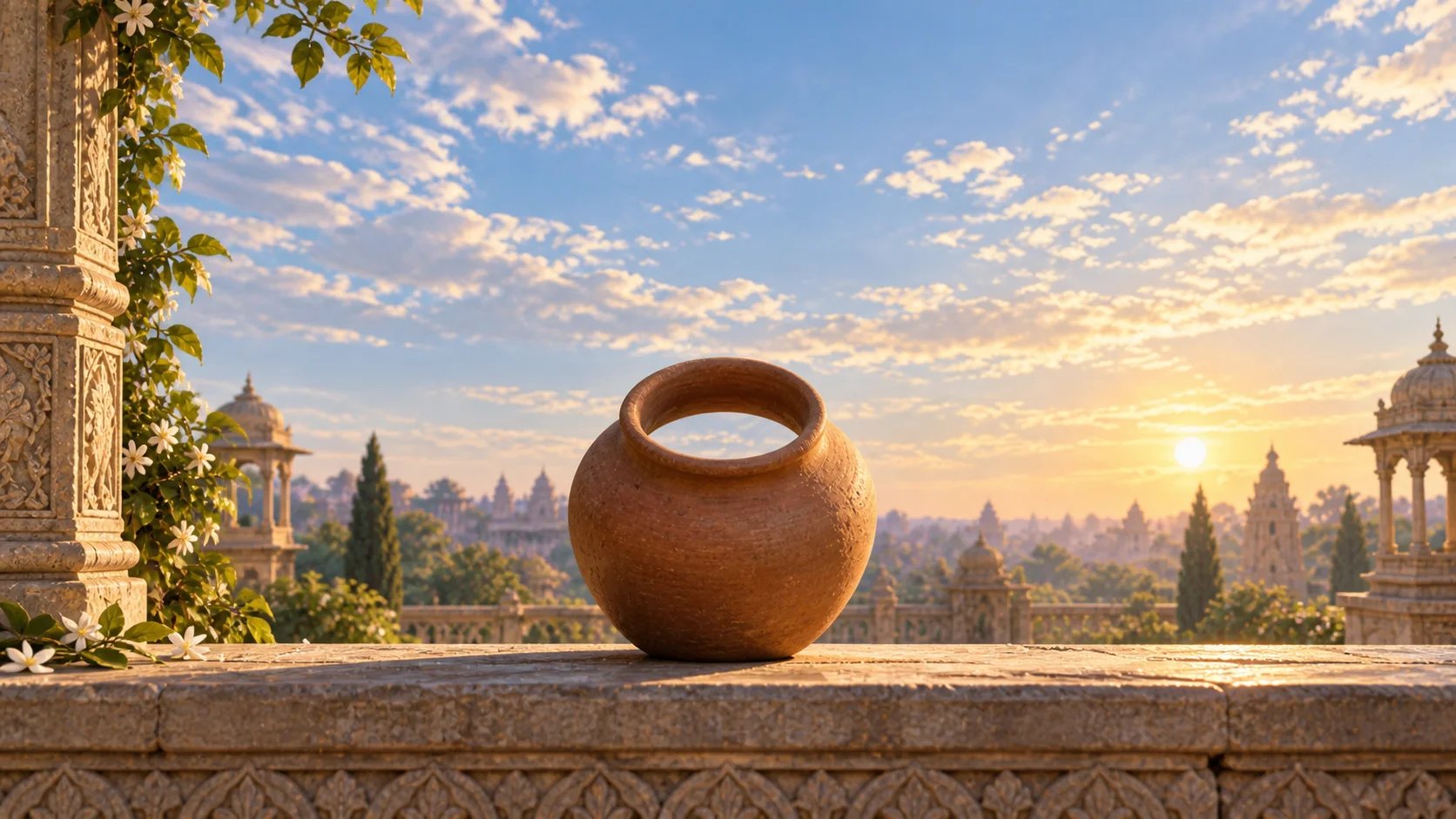
A clay pot seems to create “space inside” and “space outside.” When the pot breaks, no inner space escapes and joins an outer space. Only the temporary boundary disappears.
Likewise, names, bodies and personalities make life appear divided into completely separate selves. The verse points toward a deeper unity. Recognising this is not merely a private mystical idea; it changes how we meet another person. Compassion becomes natural when the boundary between “my life” and “your life” is no longer treated as absolute.
What Chapter 1 is really asking
Chapter 1 is not asking you to repeat “I am awareness” until it becomes another belief. It is asking you to investigate:
- The body is known. What knows it?
- A thought appears and disappears. What notices both its arrival and departure?
- Roles change across a lifetime. Is the basic fact of being aware equally temporary?
- Can you care for your responsibilities without using them to define your entire existence?
A reflection for this week
Once each day, sit quietly for five minutes. Let sounds, sensations and thoughts come and go without trying to silence them. For each experience, gently notice: “This is known.” Then ask, without forcing a verbal answer: “What is it that knows?”
Do not search for a dramatic state. The simplicity of knowing is the point.
In one sentence
You are not merely one more changing object within experience; you are the awareness in which the changing body, mind and world are known.
Next: Chapter 2 — Janaka’s Moment of Awakening.
Source note: Sanskrit verses checked against the Ashtavakra Gita text published by Sanskrit Documents. The simple meanings and commentary are original editorial explanations for Bhgwat.com and should not be treated as a complete literal translation.