When strength could no longer save the king of elephants, an old prayer rose from somewhere deeper than memory.
There was once a mountain called Trikuta, crowned by three shining peaks and ringed by an ocean bright as milk. Waterfalls braided its green slopes. Flowering trees leaned over hidden caves, and the air carried the music of birds, bees, and celestial visitors. At the mountain’s foot lay a lake so clear that the stems of its lotuses could be seen descending into blue depths.
To this lake came Gajendra, lord of a mighty elephant herd.
He walked at their head like a moving hill. When he pushed through the forest, bamboo bent aside. When he called, the valley answered. The younger elephants followed his path; the mothers trusted his watch; even the lions kept their distance. Strength had always been Gajendra’s language, and the world had always understood it.
A King Enters the Water
One morning, heat lay heavily over the forest. The herd had walked far, and the calves were tiring. Then Gajendra caught the scent of wet lotus and heard water moving through reeds. He quickened his pace. Branches broke beneath his broad forehead as he led them toward the lake.
The first touch of water was cool relief. Gajendra waded deep, drank through his trunk, and sprayed silver arcs over his back. The herd followed with delighted cries. Calves splashed between the adults. Lotus pollen drifted across the surface. For a while, the lake held nothing but abundance.

But the lake had another inhabitant.
From the dark water below, a crocodile surged upward and closed its jaws around Gajendra’s leg.
The elephant king trumpeted. The mountain seemed to shake with him. He drove his remaining feet into the lakebed and pulled. Water exploded around his body. The crocodile pulled back, at home in the very element that weakened the elephant.
When Strength Meets Its Limit
Gajendra’s herd rushed to him. They wound their trunks around his body and tried to draw him toward the bank. Together they strained until the mud churned black beneath them. Yet every gain was lost. The crocodile’s grip did not loosen.
The struggle continued beyond ordinary endurance. Gajendra fought with the same power that had broken trees and scattered predators. But power behaves differently in deep water. The crocodile grew steadier; Gajendra grew tired.
At last, the herd could do no more. They stood at the shore, calling to him, helpless in their love.
Gajendra looked toward them and understood something he had never needed to understand before: those who love us may stand beside us, pull for us, and weep for us—and still be unable to enter the deepest place of our struggle.
His body was failing. Pride had nothing left to command. The identity he had carried—king, protector, strongest of the strong—fell silent.
Sometimes surrender begins only after every lesser shelter has shown its limit.
Then, from beneath fear and exhaustion, another memory awakened.
A Voice Older Than This Life
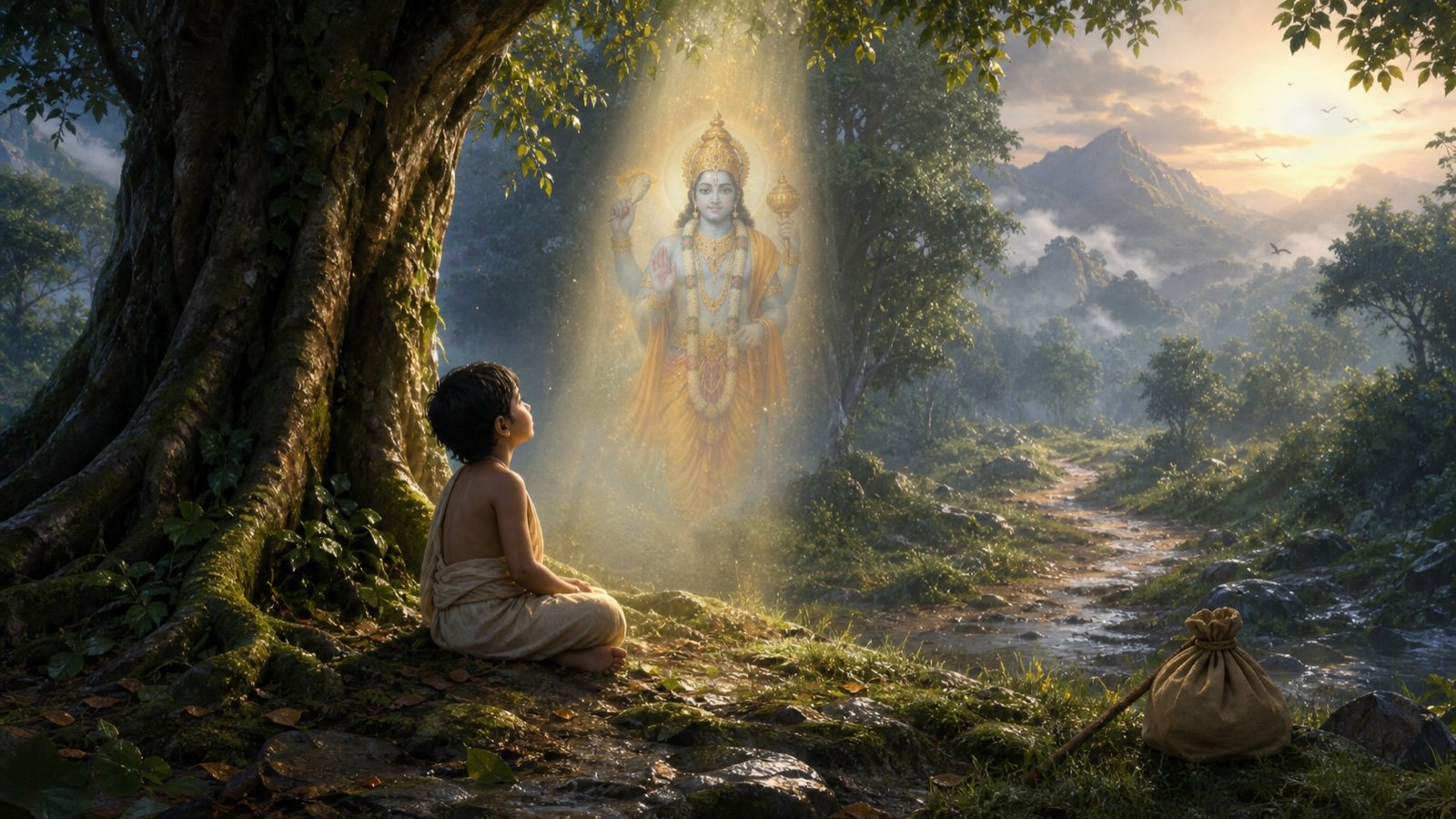
Gajendra had not always been an elephant. In an earlier life he had been Indradyumna, a king devoted to Lord Vishnu. He had left his kingdom for a life of contemplation in the mountains. One day, absorbed in meditation and observing silence, he failed to welcome the visiting sage Agastya. Taking the silence for disrespect, the sage declared that the king, unresponsive as an elephant, would be born as one.
The form had changed. The old knowledge had disappeared beneath instinct, power, and years. But devotion had left a seed.
Now, when everything else was stripped away, that seed opened.
oṁ namo bhagavate tasmai
yata etac cid-ātmakam
puruṣāyādi-bījāya
pareśāyābhidhīmahi“I bow to the Supreme source from whom consciousness arises, the seed and witness of all existence.” — a devotional rendering of Śrīmad Bhāgavatam 8.3.2
Gajendra did not ask merely for the strength to defeat an enemy. His prayer widened beyond the lake. He called to the One who is present before names and forms, who remains when worlds appear and disappear, who is the witness within every heart. He asked to be freed not only from the crocodile, but from the ignorance that made him believe he was only a body caught in danger.
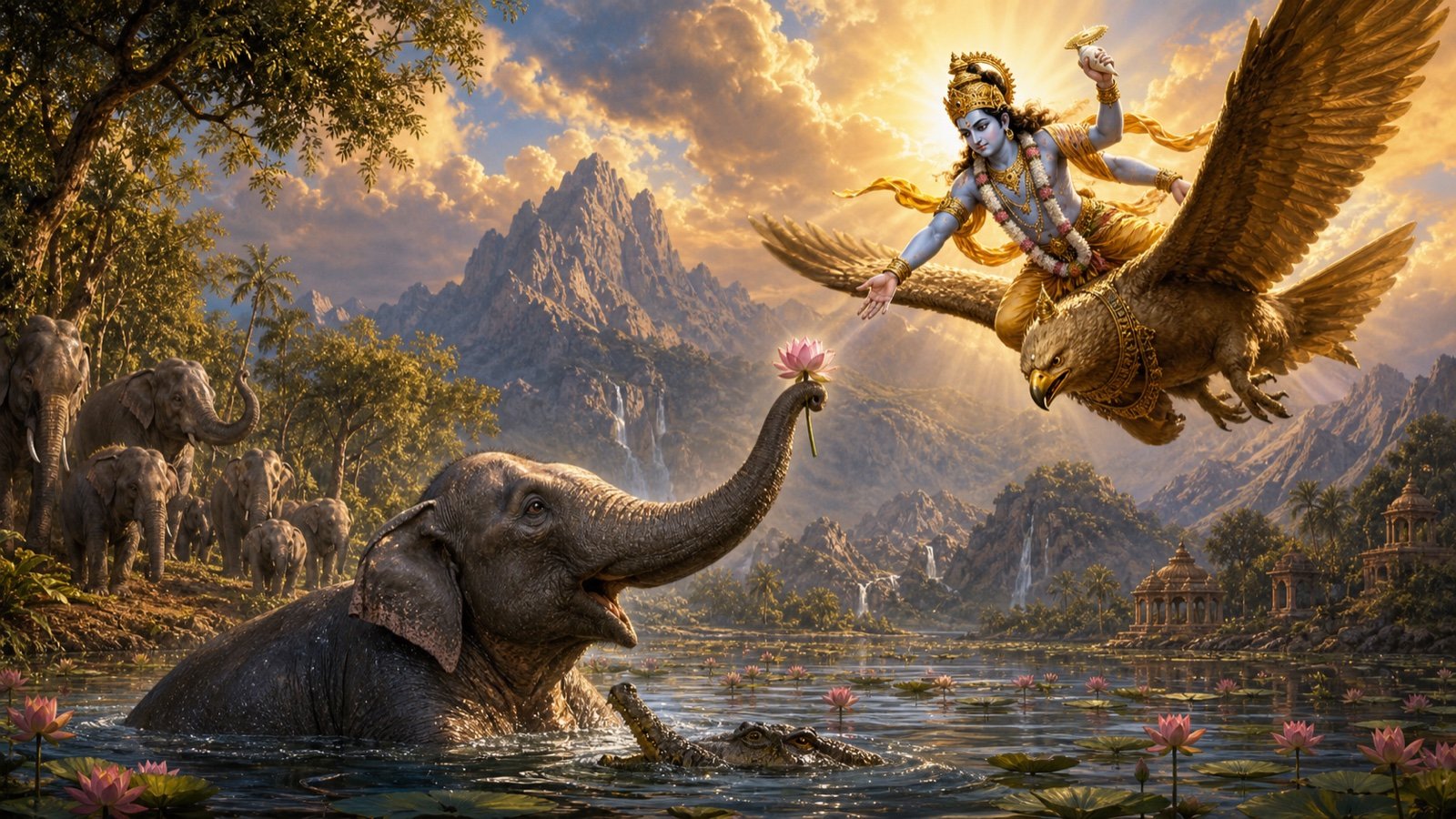
With the last of his strength, he plucked a lotus. He raised it high in his trunk.
“Narayana,” he called. “Lord of all, I bow to You.”
The offering was simple. The surrender was complete.
Grace Crosses the Sky
Lord Vishnu heard.
He came swiftly upon Garuda, radiant against the sky, bearing the discus that turns like awakened time. The devas looked on as the Lord reached the lake. Gajendra, half-submerged and barely conscious, still held up the lotus.
Vishnu descended, received the offering, and drew Gajendra from the water. The Sudarshana Chakra flashed. In an instant, the crocodile’s jaws opened and the long struggle ended.
But two beings—not one—were released that day.
The crocodile had once been Huhu, a celestial Gandharva. In careless play he had disturbed the sage Devala while the sage bathed, and had been cursed to take the form of a crocodile. Touched by the Lord’s intervention, Huhu regained his celestial form and bowed in gratitude.
Gajendra, too, was freed from the ignorance and limitation of his animal birth. The Bhagavata tells that by the Lord’s touch he attained a divine form and returned to the spiritual realm.
Flowers fell from the heavens. Drums sounded in the sky. On the bank, the herd saw the water grow calm again.
The lake had looked like the place of Gajendra’s destruction. It became the place of his liberation.
Why Gajendra’s Lotus Still Matters
The heart of this story is not that effort is useless. Gajendra fought with everything he had, and his herd did all that love could do. The teaching is subtler: effort has a rightful place, but it is not the final refuge.
We each have a “dry land” where our abilities work. We know how to plan, persuade, endure, earn, repair, or protect. Then life draws us into water too deep for familiar strength. Illness, grief, fear, time, and uncertainty can make even a powerful person feel as Gajendra felt.
At such moments, surrender is not collapse. It is clarity. It is the recognition that the deepest self was never sustained by personal strength alone.
Gajendra’s raised lotus gives devotion a permanent image: the body may be caught, the mind may be exhausted, and the world may offer no clear exit—yet the heart can still turn. The smallest sincere offering can carry the whole soul.
And grace, the story assures us, is not slow because the prayer is simple.
Three Reflections to Carry
- Use your strength. Gajendra did not surrender before he tried. Devotion does not forbid effort; it frees effort from the illusion of total control.
- Remember your center. The prayer returned when status and instinct fell quiet. Spiritual practice plants memories that can awaken in a crisis.
- Offer what remains. Gajendra had no treasure or elaborate ritual—only a lotus and a sincere heart. The value of an offering lies in its surrender.
Scriptural Basis
This is an original literary retelling based on the narrative sequence in the Śrīmad Bhāgavatam, Canto 8. It preserves the central events while using fresh scene-setting and reflection for modern readers.
- Canto 8, Chapter 2 — Gajendra’s crisis at the lake
- Canto 8, Chapter 3 — Gajendra’s prayers of surrender
- Canto 8, Chapter 4 — liberation and the former lives of Gajendra and Huhu
The water may be deep. The lotus can still rise.
Continue exploring Bhagwat Mahapuran stories and teachings on bhgwat.com.