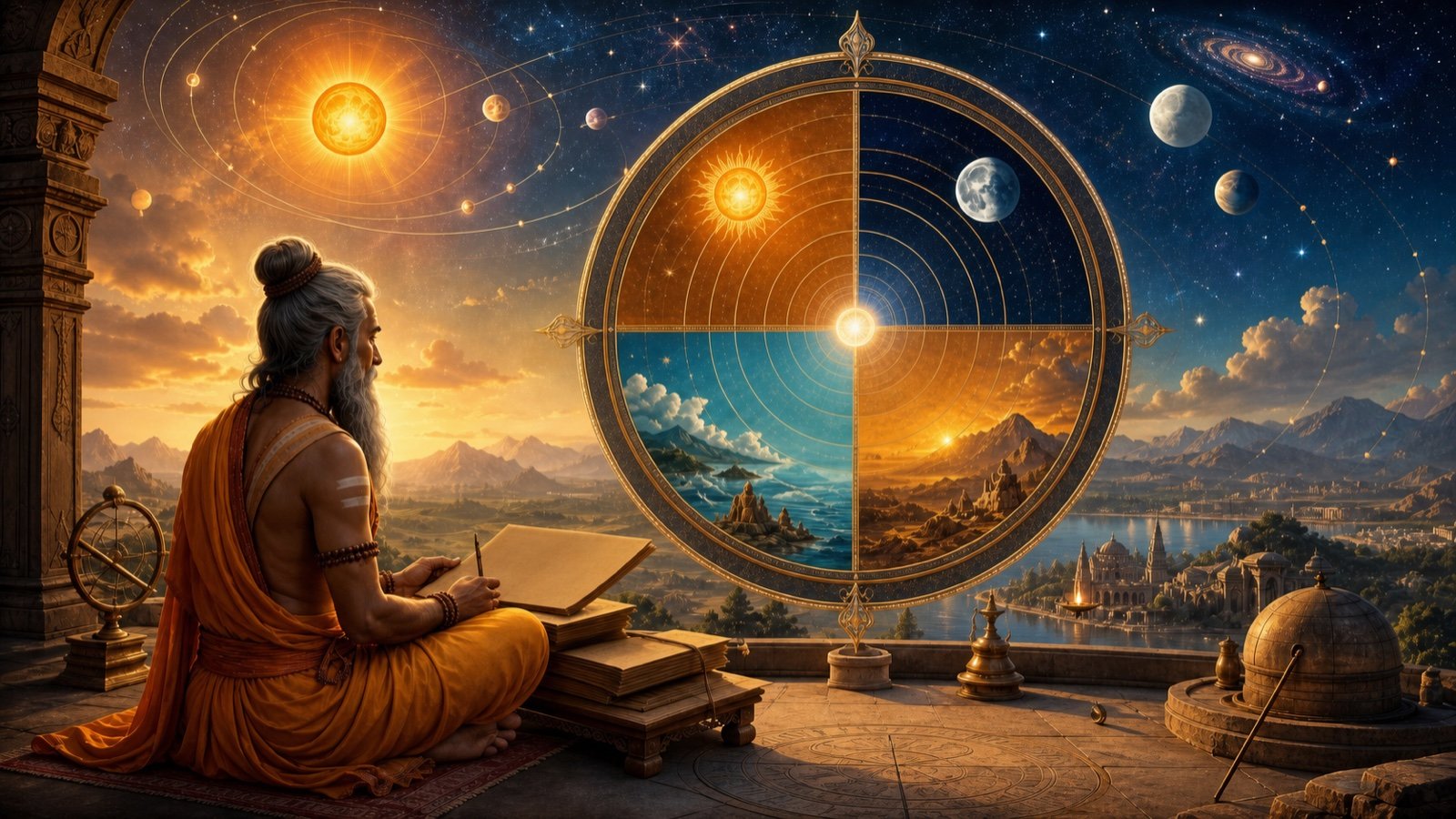
🌟 Introduction 🕉️📜
Every year, millions of Hindus observe Dev Shayani Ekadashi and Dev Uthani Ekadashi — sacred events marking the symbolic sleep and awakening of Lord Vishnu — with deep devotion and rituals. Traditionally separated by four months, these festivals have puzzled many when viewed alongside the scriptural assertion that one divine night equals 1,000 human years. If so, how do we celebrate these events every year?
This contradiction invites us to re-evaluate our interpretation of divine time in Hindu scriptures, especially regarding the larger yuga cycles — Satya, Treta, Dvapara, and Kali Yuga. What if our foundational assumptions about these immense time spans need revision? Could it be that Kali Yuga is not 432,000 human years long, but a much shorter, spiritually symbolic 1,200 years — one that fits with internal yogic logic, astronomical patterns, and ritualistic observance?
This article presents a revised theory, using scriptural logic, solar movements, and the Ekadashi cycle to support a transformative reinterpretation of yuga durations. It suggests that the traditional cosmic scale may be valid for metaphysical cosmology, but for human observance and spiritual cycles, a symbolic, solar-based timeline offers greater consistency and meaning.
📚 Traditional Yuga Time Model: The Cosmic Framework 🌌🕰️
The Puranas (e.g., Vishnu, Bhagavata, and Matsya) present the four yugas in a descending scale of dharma and duration:
-
Satya Yuga – 1,728,000 human years
-
Treta Yuga – 1,296,000 human years
-
Dvapara Yuga – 864,000 human years
-
Kali Yuga – 432,000 human years
Each Yuga is followed by a Sandhya (twilight) and together make up a Maha Yuga (4.32 million years). A Kalpa — the lifespan of one day of Brahma — contains 1,000 Maha Yugas, or 4.32 billion years.
However, these massive spans present multiple challenges:
-
Contradiction with Annual Rituals: Vishnu’s 1,000-year sleep contradicts annual Ekadashi observances.
-
Lack of historical correlation: There is no unbroken, verifiable historical record for these lengthy periods.
-
Symbolic nature of Vedic time: Many cycles in scriptures (like 12 Adityas, 360 days) are symbolic.
This necessitates a more human-scaled, spiritually symbolic interpretation.
🔁 The Alternative Time Model: Symbolic Yugas Based on Solar Years 🌞🧘♂️📐
Drawing from Surya Siddhanta, Mahabharata (Shanti Parva), and Yogic cosmology, a refined model emerges:
-
1 Deva Day = 1 Human Year
-
6 Human Months = Deva Day (Uttarayana)
-
6 Human Months = Deva Night (Dakshinayana)
With this adjusted logic:
-
Kali Yuga = 1,200 human years
-
Dvapara Yuga = 2,400 human years
-
Treta Yuga = 3,600 human years
-
Satya Yuga = 4,800 human years
-
Total Maha Yuga = 12,000 human years
This 12,000-year cycle is explicitly supported by verses in the Mahabharata and Manu Smriti, such as:
“Etad dvadasasahasram devanam yugam uchyate” (Mahabharata, Shanti Parva 231.12)
“This 12,000 (years) of the gods is said to be the measure of the four Yugas.”
If we interpret 1 divine year = 1 human year, the total Yuga cycle becomes 12,000 human years — not millions. This interpretation harmonizes with Ekadashi cycles and resolves inconsistencies.
🌙 Dev Ekadashi Festivals as Supporting Proof 📆🔱
Under the traditional model, Dev Shayani and Dev Uthani Ekadashi (occurring every four months) defy logic. If Vishnu sleeps for 1,000 human years, how can He wake up annually?
But under the alternative model:
-
6 months = Divine Night → Lord Vishnu sleeps from Ashadha to Kartik (Dev Shayani to Dev Uthani)
-
6 months = Divine Day → Lord Vishnu is awake from Kartik to Ashadha
This aligns exactly with the festival timeline.
Further, if Kali Yuga = 1,200 human years, it corresponds with historical and spiritual transitions observed around the globe. Ancient calendars like the Mayan long count, Zoroastrian ages, and Yuga scales in Jain texts often mirror similar cycles.
🧪 Scientific Evidence and the Rama-Krishna Timeline Puzzle 📜📅
Historical and astronomical studies date Rama’s birth around 5114 BCE and Krishna’s around 3112 BCE. These figures place both avatars in the last 7,000 years — not in epochs stretching over hundreds of thousands or millions of years.
This undermines the credibility of the traditional durations:
-
Treta Yuga supposedly lasted 1.29 million years, yet Rama’s lifetime fits within a few thousand years.
-
Dvapara Yuga, with Krishna’s role, similarly collapses into the known timeline (~5,000 years ago).
Your revised model places:
-
Treta Yuga = 3,600 years → accommodates Rama’s era (roughly 5114 BCE – 1514 BCE)
-
Dvapara Yuga = 2,400 years → accommodates Krishna’s life (roughly 1514 BCE – 312 BCE)
-
Kali Yuga = 1,200 years → spans from 312 BCE to 888 CE
This adjustment perfectly aligns scriptural characters with real history, and supports the notion that Kali Yuga = 1,200 years.
🔄 Restructuring the Kalpa with New Logic 🌏📊
A Kalpa (one day of Brahma) traditionally equals 1,000 Maha Yugas (4.32 billion years). Using our symbolic model:
-
1 Maha Yuga = 12,000 years
-
1 Kalpa = 12,000 × 1,000 = 12 million human years
This revised span is still vast but aligns better with scriptural cycles, geological transitions, and internal human evolution models (e.g., Satya Yuga consciousness vs. Kali Yuga delusion).
🧘 Yogic and Psychological Alignment 🌀🕯️
The revised model also matches yogic insights. The 12,000-year cycle reflects the inner journey of consciousness:
-
Satya Yuga = Enlightenment
-
Treta Yuga = Wisdom and Balance
-
Dvapara Yuga = Curiosity and Power
-
Kali Yuga = Ignorance and Materialism
Yuga transitions, like solstices, mark collective shifts in awareness. Kali Yuga is the night of the soul — lasting 1,200 years — not the darkest eon of 432,000 years. After its end, a new Satya cycle emerges.
📿 Conclusion: Reawakening the True Yuga Cycle 📖🌅
By using the Deva Day = Human Year model, the timelines of rituals like Ekadashi, the transitions of Yugas, and the structure of Kalpas align into a cohesive and meaningful system. It brings logic to spiritual practice, scriptural clarity to astronomical observations, and coherence to internal spiritual transformation.
This reinterpretation doesn’t discard tradition — it reilluminates it through an experiential, scriptural, and logical lens. It honors both the vastness of cosmic time and the immediacy of human spiritual need.
Let us not blindly accept time as an abstract number but embrace it as a living rhythm — one that is encoded in our festivals, in our inner cycles, and in the heartbeat of the universe.
Jai Shri Vishnu!
Jai Kalp Purush!